Cloud: Tiers and Instances
- Use your portal's Products tab to raise or modify a Free node, a Development node, a Production cluster, or a Serverless product.
- Free and Development nodes, as well as Production "basic" grade clusters, are operated by burstable instances.
- The Production cluster grades Standard and Performance are Reserved clusters.
In this page:
A Free Cloud Node
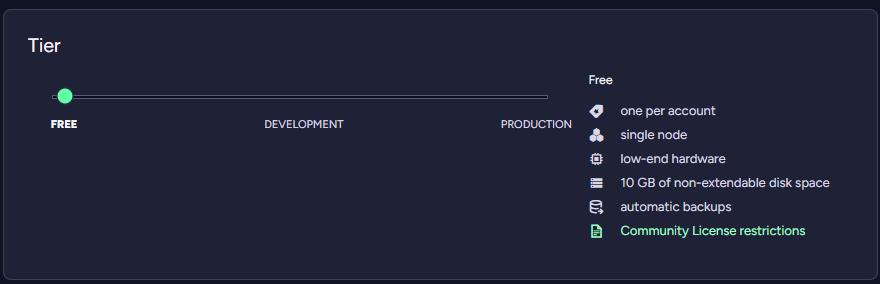
Free RavenDB cloud nodes are great for experiments and evaluation. They are equipped with the
most basic configuration and capabilities. They have a single node and no Service-Level Agreement (SLA).
You can run only one free node per account.
To raise a free cloud node, use the Products tab to create a free-tier instance.
-
A free instance is identical to a development Dev10 instance.
It comes with a monthly credit of $14, used to cover the cost of the instance and incidentals like backup storage and traffic.If your free instance uses more resources than the provided credit, you'll need to pay for these resources or stop your instance.
-
The free instance is limited to the community subset of features.
-
If you don't use your free instance for over 30 days, it will be terminated.
A Development Cloud Server
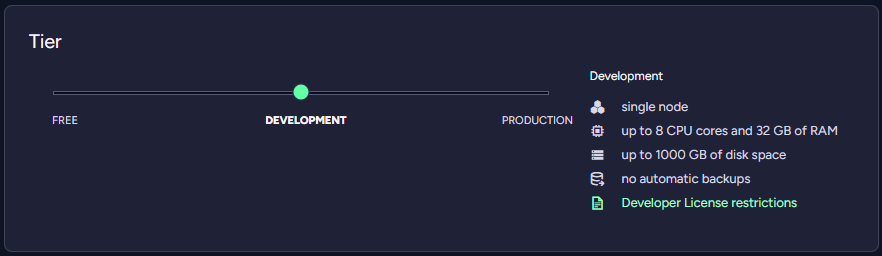
A development server is equipped with all of RavenDB's features but is not suitable for production for the following reasons:
- A single-node configuration (no replication).
- Burstable CPU usage, suitable for small to medium production loads.
Burstable instances can become throttled if usage exceeds allocated resources. - Lack of backup procedure.
- No Service Level Agreement.
To raise a cloud Development server, create a product using the Products tab and select the Development tier.
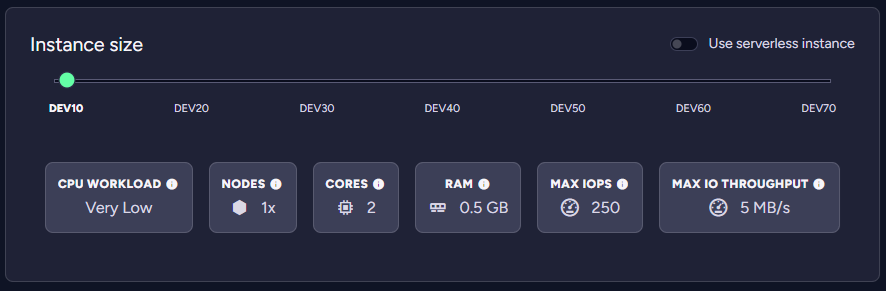
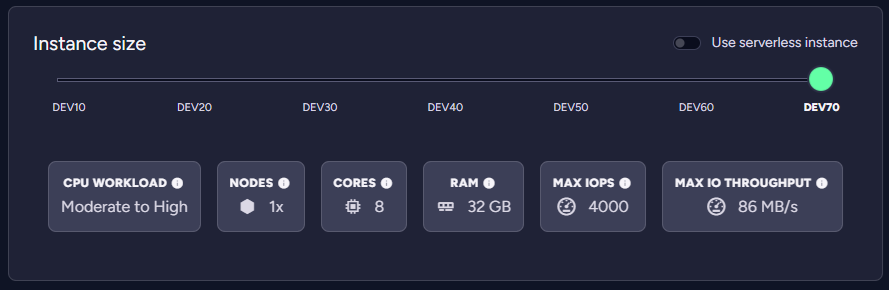
Select your server's configuration
Select a configuration from Dev10 to Dev70.
The configurations are increasingly more and more powerful.
Select your storage
Select your storage type and size.
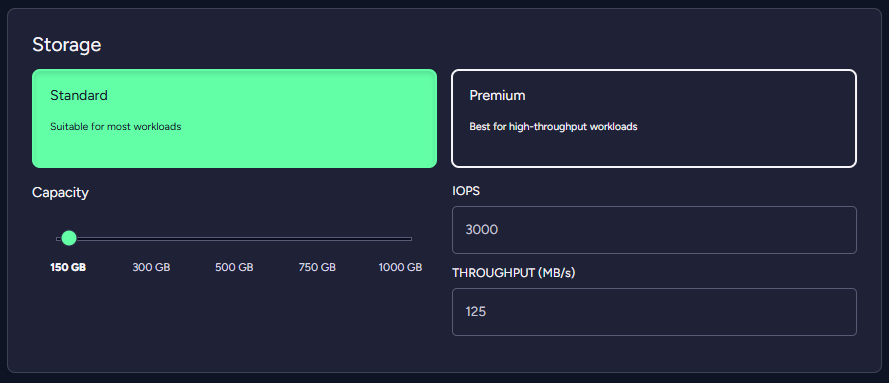
In addition to the CPU / memory resources allocated to your instances, you can select the type of storage that will be assigned to your RavenDB instances. It is fairly obvious why the size of the storage matters, but it is important to also understand the impact of the storage type and allocated IOPS on the overall performance.
RavenDB, as a database, is sensitive to I/O latencies resulting from slow storage. If your instances are running into high I/O latencies, RavenDB will alert you to the issue so you can upgrade the type of storage you are using and the number of IOPS reserved for your instances.
A Production Cloud Cluster
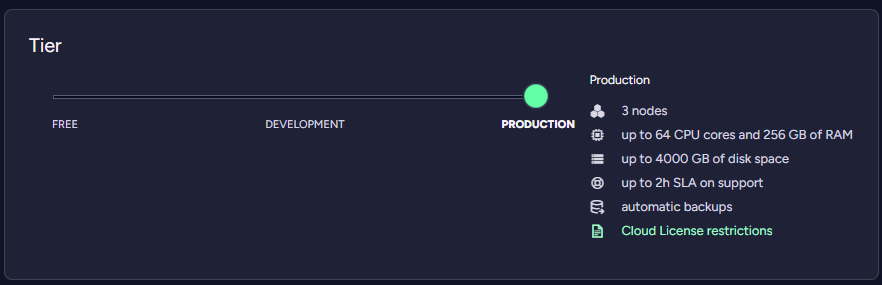
The default production configuration is a three-node cluster, provisioned in separate availability zones for maximum durability.
RavenDB Cloud also offers multi-region clusters to minimize local latency and clusters
with a higher number of nodes to further distribute the cluster's workload.
Contact Support to provision customized cloud-based clusters
with configurations that suit your needs.
Production tier clusters can be also extended by additional product nodes.
This option is not available for PS instance types.
Please be aware that cloud cluster nodes are provided with dynamic IP addresses and are not guaranteed to keep the same addresses if the instances they reside on are rebooted.
The production tier offers three instance levels:
The tier you select must have sufficient compute, memory, and disk resources to run backups on top
of your normal workload. Undersized tiers can cause backup jobs to fail.
See Tier Requirements and Failure Disclaimer
for details.
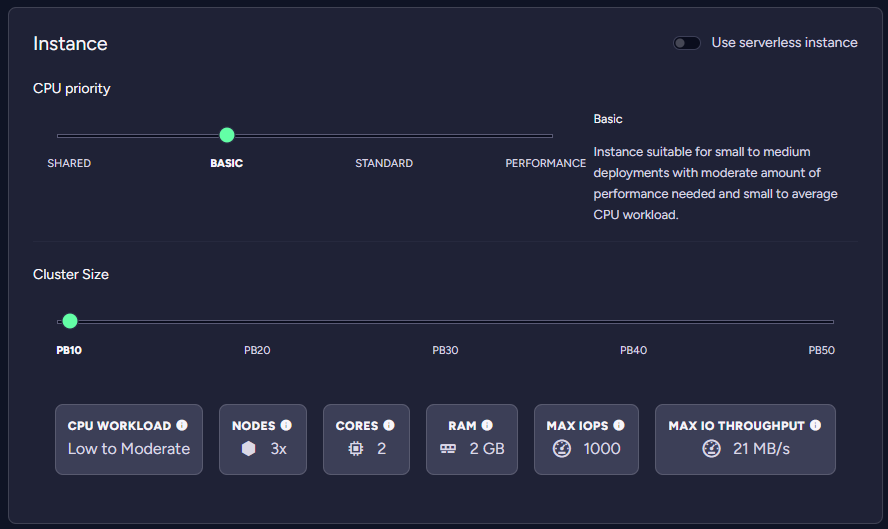
1. Basic-grade Production Cluster
Basic production clusters are burstable.
While suitable for low to medium workloads, they trade-off peak efficiency for lower costs.
If burstable instances use more than their allocated budget, they can become throttled.
2. Standard-grade Production Cluster
The resources of standard production clusters are reserved.
The cluster can utilize them at all times, and is equipped to handle constant production load.
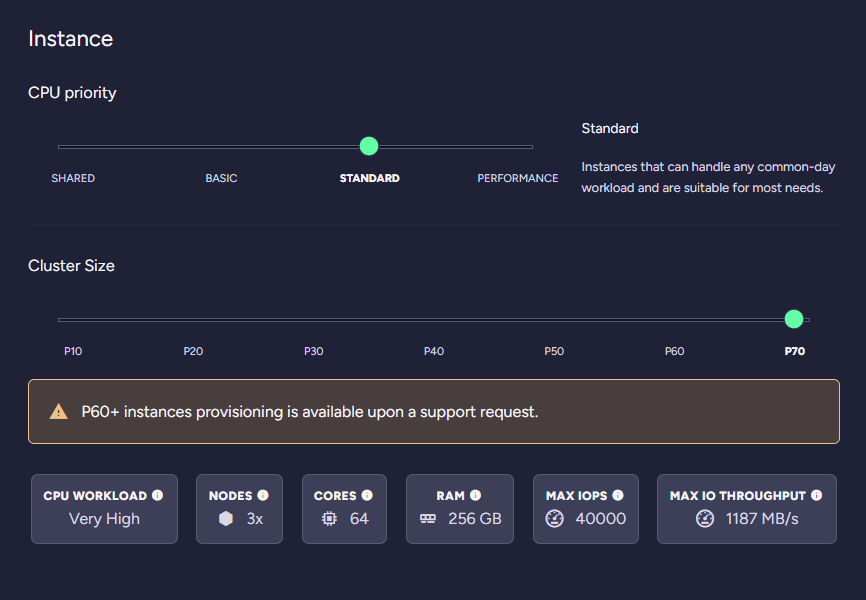
Use the slide-bars to select your Standard Production cluster's configuration and storage.
P60 and P70 products can be created only via support request.
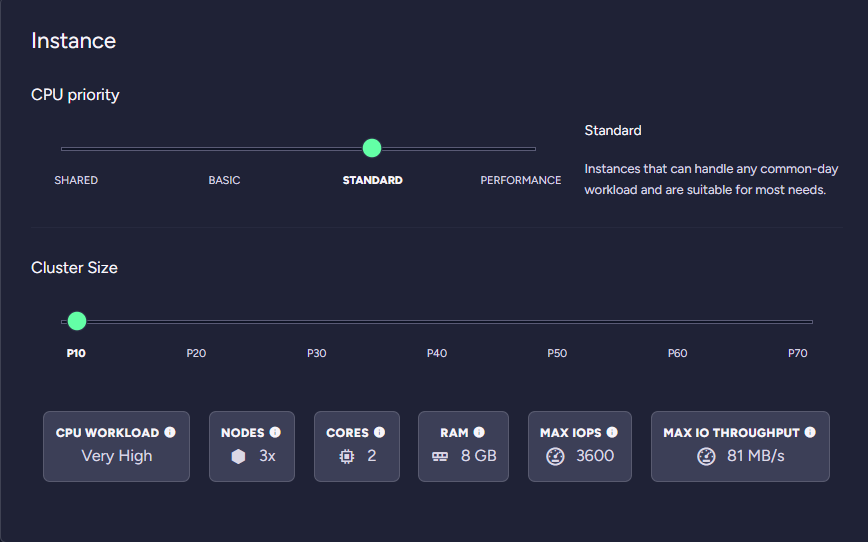
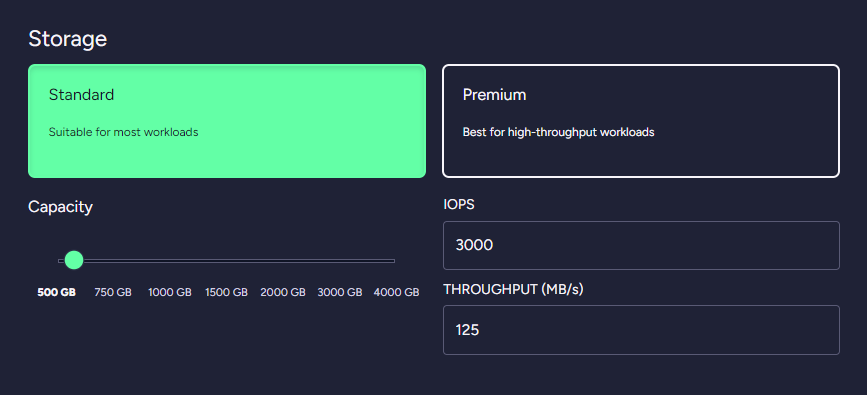
In addition to the CPU / memory resources allocated to your instances, you can select the type of storage that will be assigned to your RavenDB instances. It is fairly obvious why the size of the storage matters, but it is important to also understand the impact of the storage type and allocated IOPS on the overall performance.
RavenDB, as a database, is sensitive to I/O latencies resulting from slow storage. If your instances are running into high I/O latencies, RavenDB will alert you to the issue so you can upgrade the type of storage you are using and the number of IOPS reserved for your instances.
3. Performance-grade Production Cluster
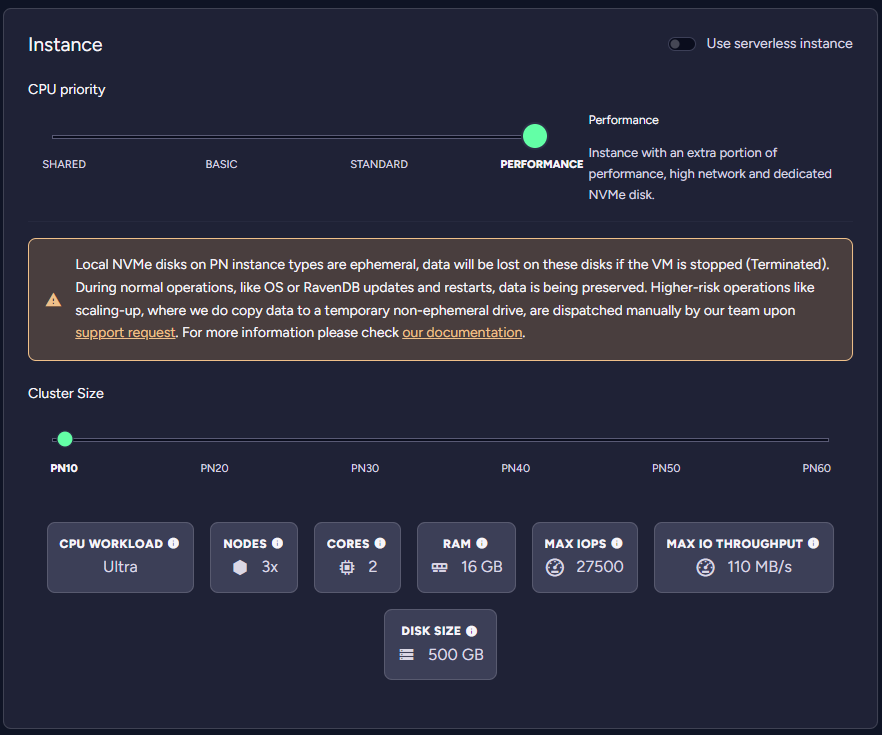
Performance tier cluster are special reserved production clusters featuring high-throughput and low latency with a directly mapped local NVMe storage. When multiple NVME disks are available, in order to achieve the best possible throughput and to get as many IOPS as possible, multiple NVME volumes are striped together with RAID0.
Scaling up and ephemeral drives
Local NVMe disks on PN instance types are ephemeral, data will be lost on these disks if the VM is stopped (terminated). During normal operations, like OS or RavenDB updates and restarts, data is being preserved and there is no need to worry about the ephemeral nature of the disks. Higher-risk operations like scaling-up, where we do copy data to a temporary non-ephemeral drive, are dispatched manually by our team upon Support Request created in the RavenDB Cloud Portal.
All products in this category are offered only with high-availability cluster of a minimum 3 nodes to balance the ephemeral nature of the disks.
Snapshot backups
Since this type of RavenDB clusters is designed to hold data of terrabyte order of magnitude, by default PN instance types run backups of type Snapshot to ensure fast data restore.
Local NVMe drives on PN clusters are encrypted by default using hardware-based encryption.
A Serverless Cloud Product
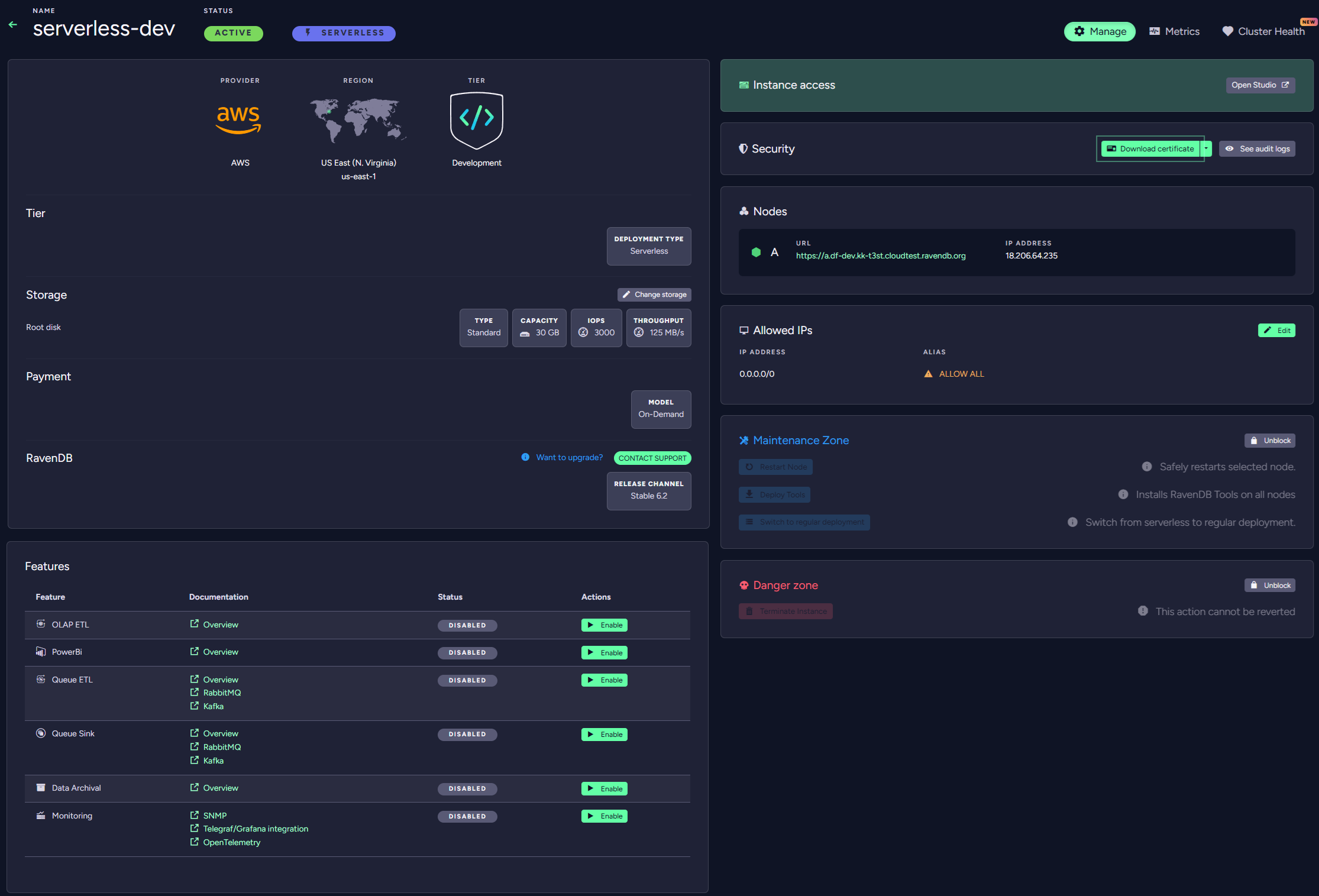
A Serverless product is a fully managed RavenDB cluster that automatically adjusts its size based on your actual workload — without you having to choose or change an instance type manually.
It is available for both the Development and Production tiers and is suited for:
- Proofs of concept and evaluation.
- Small production environments with irregular or unpredictable load patterns.
- On-Demand billing users who prefer to pay only for what they use.
Serverless is available on On-Demand billing only. It is not available for yearly contracts.
For instructions on how to create a Serverless product, see Provisioning a New Product.
Autoscaling
The cluster scales up and down automatically within a band you choose, driven by three sustained signals: load average, available memory and IO wait. Scaling moves one step at a time, and a grace period is applied before each step to prevent flapping caused by short load spikes.
Serverless Autoscaling is always enabled, and only its instance range — the lowest and highest type — is configurable; the thresholds and grace periods are managed for you. See Serverless Autoscaling for details.
Billing
Serverless products are billed the same way as regular products — by effective daily usage. Each day, the actual instance size, backup storage, and support are metered into your daily cost. The billing period closes on the 25th of each month (UTC).
Switching to Regular Deployment
For instructions on how to convert a Serverless product to a regular deployment, see Maintenance and Danger Zones.