Maintaining a Running Balance
-
This example shows how to use CDC Sink patches to maintain a computed aggregate on a RavenDB document
as individual event rows arrive from PostgreSQL. -
For detailed instructions on creating a CDC Sink task with the Client API or Studio,
see Create a CDC Sink task. -
In this article:
Source schema
An accounts table and a transactions table:
- SQL
CREATE TABLE accounts (
    account_id SERIAL PRIMARY KEY,
    owner      TEXT NOT NULL,
    currency   TEXT NOT NULL DEFAULT 'USD'
);

CREATE TABLE transactions (
    txn_id     SERIAL PRIMARY KEY,
    account_id INT NOT NULL REFERENCES accounts(account_id),
    amount     NUMERIC(12,2) NOT NULL,
    type       TEXT NOT NULL CHECK (type IN ('credit', 'debit')),
    created_at TIMESTAMPTZ DEFAULT now()
);
Goal
Store each account as a RavenDB document with a Balance field that reflects the running total of all transactions.
Transaction rows are embedded as an array for history, and Balance is maintained using patch logic.
REPLICA IDENTITY setup
-
The
transactionstable usestxn_idas its primary key.
The join columnaccount_idis not part of that primary key. -
By default, PostgreSQL
REPLICA IDENTITYsends only primary-key columns.
WithoutREPLICA IDENTITY FULL, DELETE events fortransactionsrows would not includeaccount_id,
and CDC Sink could not route the deleted transaction to the correct account document. -
For this example to handle deleted transactions, CDC Sink must receive the
account_idvalue in PostgreSQL DELETE events. SetREPLICA IDENTITY FULLon thetransactionstable:- SQL
ALTER TABLE transactions REPLICA IDENTITY FULL;Learn more in REPLICA IDENTITY.
Task configuration
Via the Client API
Define the task with the client API:
- csharp
var config = new CdcSinkConfiguration
{
    Name = "Accounts-CDC-Sink",
    ConnectionStringName = "ConnectionStringToPostgreSQL",
    Tables =
    [
        new CdcSinkTableConfig
        {
            CollectionName = "Accounts",
            SourceTableSchema = "public",
            SourceTableName = "accounts",
            PrimaryKeyColumns = ["account_id"],
            Columns =
            [
                new CdcColumnMapping() { Column = "account_id", Name = "AccountId" },
                new CdcColumnMapping() { Column = "owner",      Name = "Owner" },
                new CdcColumnMapping() { Column = "currency",   Name = "Currency" },
            ],
            EmbeddedTables =
            [
                new CdcSinkEmbeddedTableConfig
                {
                    SourceTableSchema = "public",
                    SourceTableName = "transactions",
                    PropertyName = "Transactions",
                    Type = CdcSinkRelationType.Array,
                    JoinColumns = ["account_id"],
                    PrimaryKeyColumns = ["txn_id"],
                    Columns =
                    [
                        new CdcColumnMapping() { Column = "txn_id",     Name = "TxnId" },
                        new CdcColumnMapping() { Column = "amount",     Name = "Amount" },
                        new CdcColumnMapping() { Column = "type",       Name = "Type" },
                        new CdcColumnMapping() { Column = "created_at", Name = "CreatedAt" },
                    ],
                    // Runs after a transaction is inserted or updated;
                    // adjusts Balance by replacing the previous contribution with the new one.
                    Patch = """
                        const oldAmount = $old?.Amount || 0;
                        const newAmount = $row.amount || 0;
                        const sign = $row.type === 'credit' ? 1 : -1;
                        const oldSign = $old?.Type === 'credit' ? 1 : -1;
                        this.Balance = (this.Balance || 0)
                            - (oldSign * oldAmount)
                            + (sign * newAmount);
                        """,
                    // Runs after a transaction is deleted;
                    // uses $old to subtract the removed transaction's last stored contribution.
                    OnDelete = new CdcSinkOnDeleteConfig
                    {
                        Patch = """
                            const deletedAmount = $old?.Amount || 0;
                            const sign = $old?.Type === 'credit' ? 1 : -1;
                            this.Balance = (this.Balance || 0) - (sign * deletedAmount);
                            """
                    }
                }
            ]
        }
    ]
};

await store.Maintenance.SendAsync(new AddCdcSinkOperation(config));
Via Studio
In Studio, configure how the accounts source table maps to the Accounts target collection,
then add transactions as an embedded table for each account.
First, configure the root accounts table:
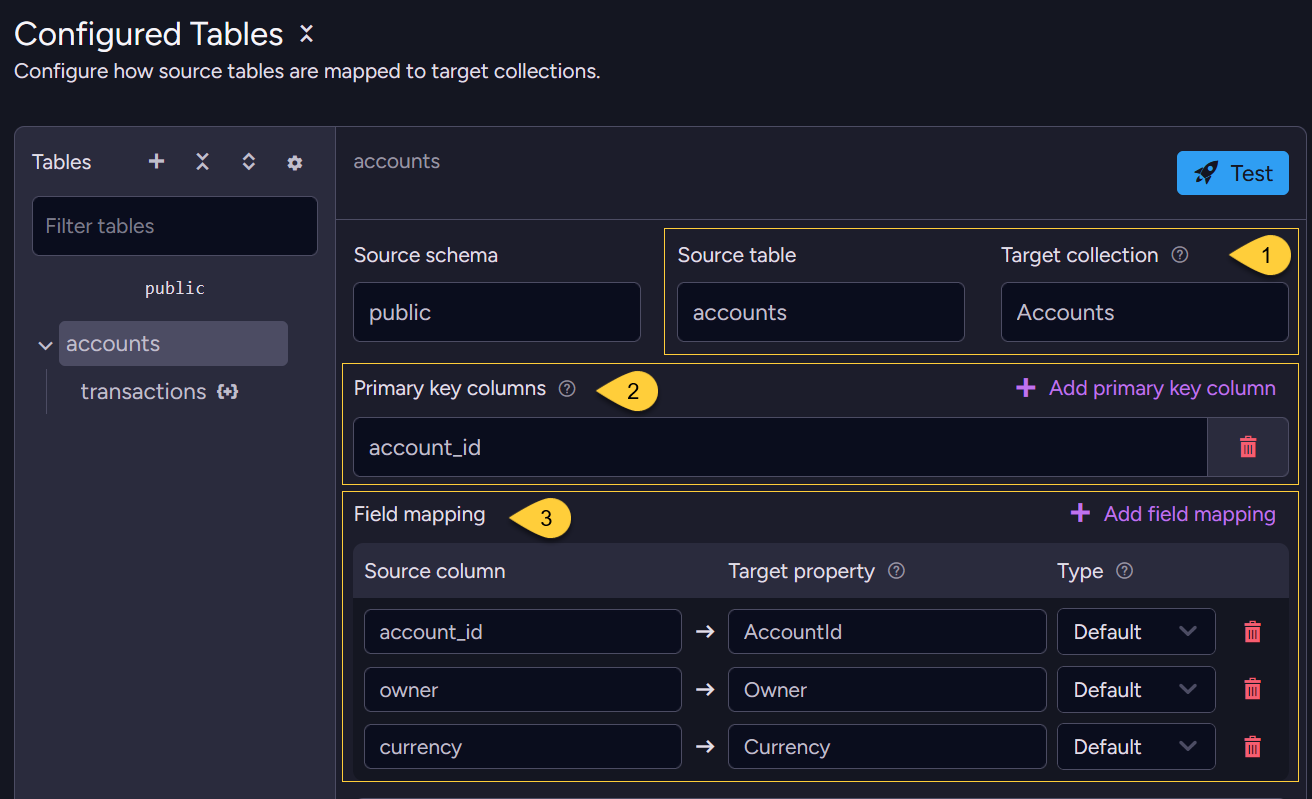
- Source table → target collection
Theaccountstable maps to theAccountscollection.
This is a root table, so each row becomes its own document. - Primary key columns
account_idis used to build the document ID for each account. - Field mapping
Maps each source column to its target property
(account_id→AccountId,owner→Owner,currency→Currency).
Then add the embedded transactions table:
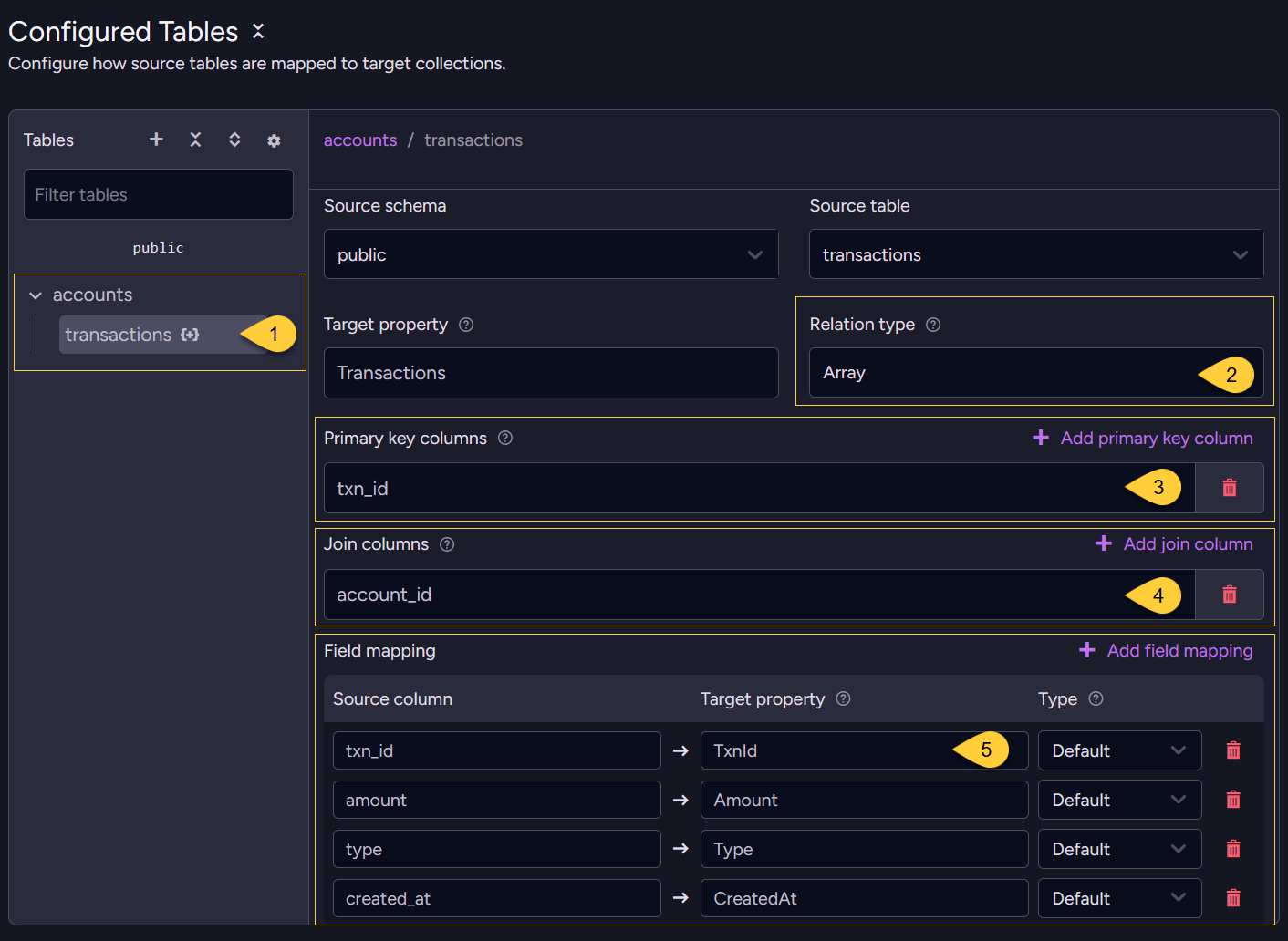
- Embedded table
transactionsis configured as an embedded table inside theaccountsdocument, not as its own collection. - Relation type
Each account stores its transactions as a JSON array (Type: Arrayin the config). - Primary key columns
txn_ididentifies each array element, so later updates and deletes patch the correct transaction. - Join columns
account_idlinks each transaction row to its parent account document.
In this example, PostgreSQL DELETE events need this value to route deleted transactions correctly. - Field mapping
Maps each source column to its target property, matching theColumnslist in the config.
The embedded transactions table and its balance patches (Patch / OnDelete.Patch) are defined under Advanced settings.
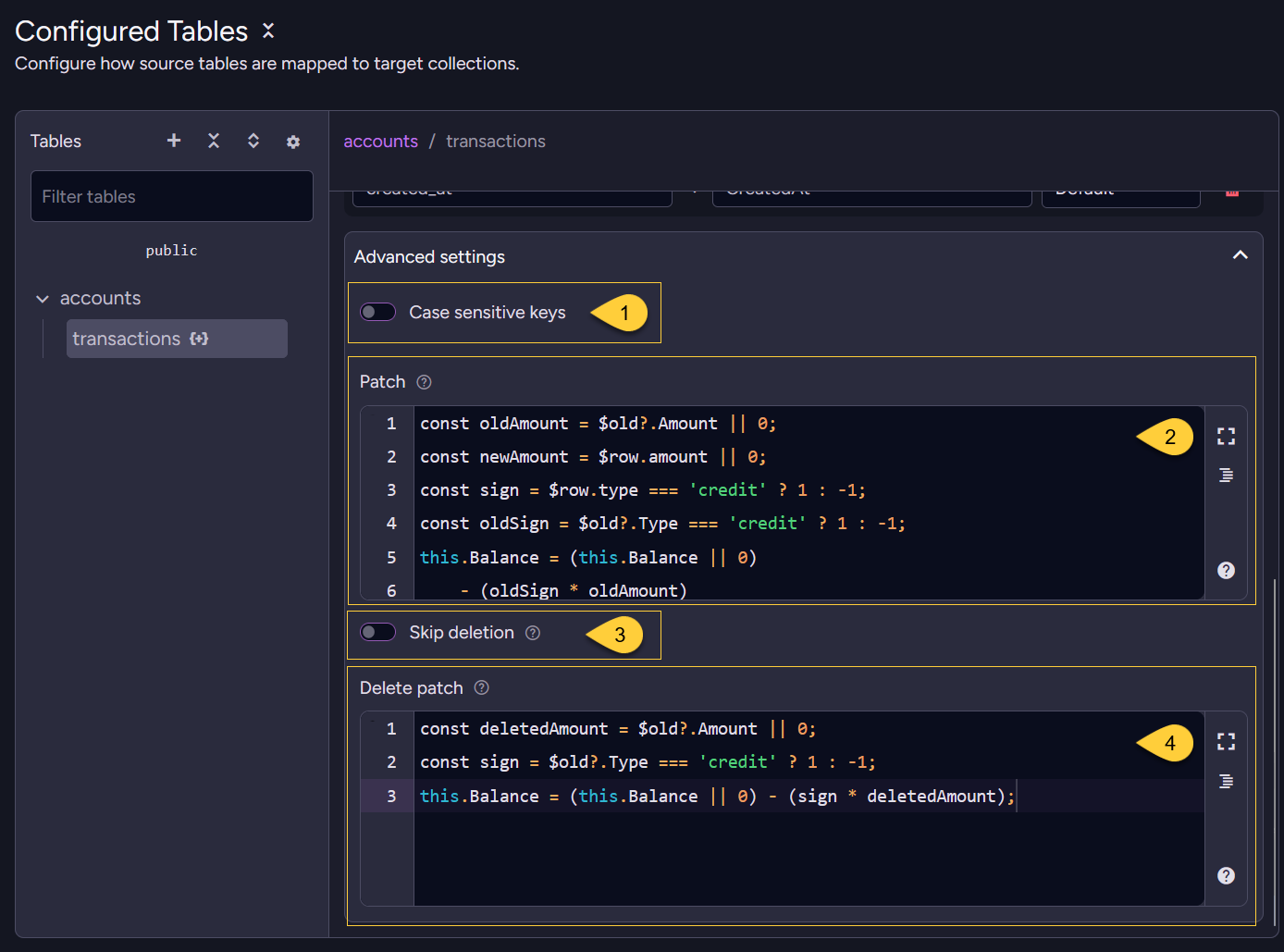
- Case sensitive keys
Controls whether primary-key and map-key matching is case sensitive.
It only affects string keys, so it has no effect in this example, where the key is the numerictxn_id. - Patch
The INSERT/UPDATE patch that maintainsBalance;
runs on the parent account document after a transaction is added or updated. - Skip deletion
Maps toIgnoreDeletes.
Leave this off for this example.
Off = CDC Sink removes the deleted transaction item from the array, and the delete patch updatesBalance.
On = CDC Sink skips the automatic removal. If a delete patch is configured, the patch still runs. - Delete patch
TheOnDelete.Patchscript reverses the deleted transaction's contribution toBalance.
Alternatively, toggle Raw config and paste the equivalent JSON:
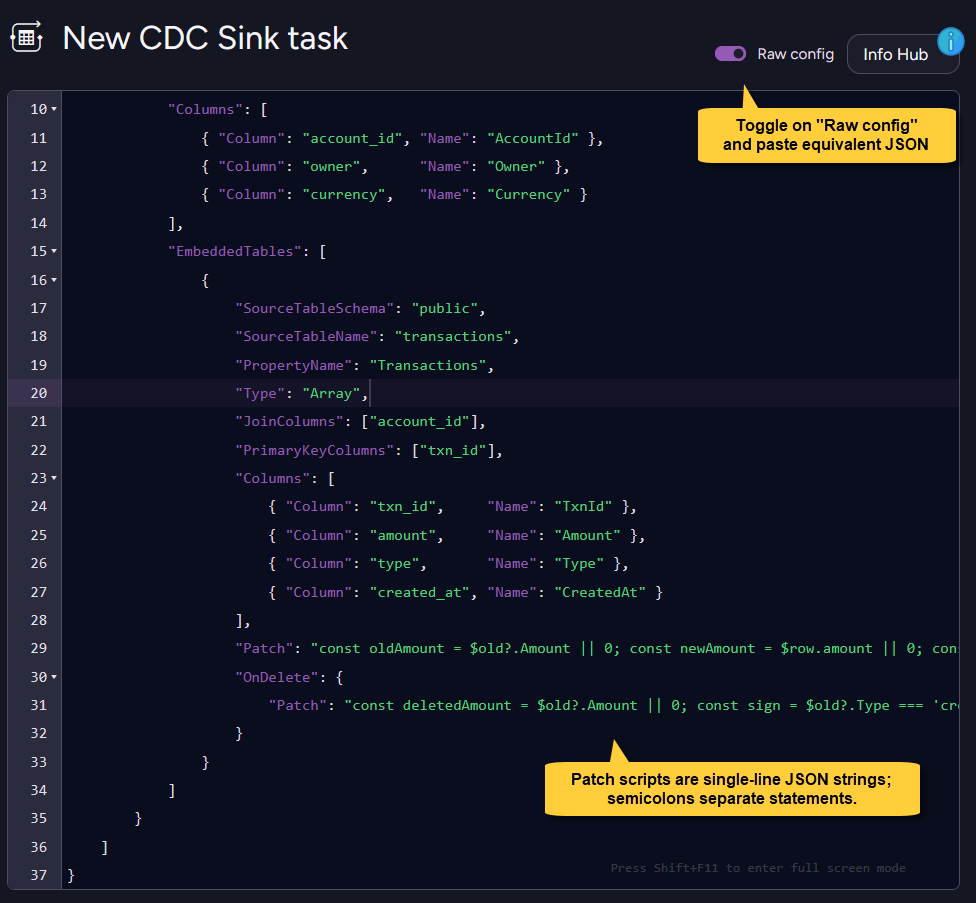
- Raw config (JSON)
{
    "Name": "Accounts-CDC-Sink",
    "ConnectionStringName": "ConnectionStringToPostgreSQL",
    "Tables": [
        {
            "CollectionName": "Accounts",
            "SourceTableSchema": "public",
            "SourceTableName": "accounts",
            "PrimaryKeyColumns": ["account_id"],
            "Columns": [
                { "Column": "account_id", "Name": "AccountId" },
                { "Column": "owner",      "Name": "Owner" },
                { "Column": "currency",   "Name": "Currency" }
            ],
            "EmbeddedTables": [
                {
                    "SourceTableSchema": "public",
                    "SourceTableName": "transactions",
                    "PropertyName": "Transactions",
                    "Type": "Array",
                    "JoinColumns": ["account_id"],
                    "PrimaryKeyColumns": ["txn_id"],
                    "Columns": [
                        { "Column": "txn_id",     "Name": "TxnId" },
                        { "Column": "amount",     "Name": "Amount" },
                        { "Column": "type",       "Name": "Type" },
                        { "Column": "created_at", "Name": "CreatedAt" }
                    ],
                    "Patch": "const oldAmount = $old?.Amount || 0; const newAmount = $row.amount || 0; const sign = $row.type === 'credit' ? 1 : -1; const oldSign = $old?.Type === 'credit' ? 1 : -1; this.Balance = (this.Balance || 0) - (oldSign * oldAmount) + (sign * newAmount);",
                    "OnDelete": {
                        "Patch": "const deletedAmount = $old?.Amount || 0; const sign = $old?.Type === 'credit' ? 1 : -1; this.Balance = (this.Balance || 0) - (sign * deletedAmount);"
                    }
                }
            ]
        }
    ]
}
Resulting documents
After three transactions (credit 100, debit 30, credit 50):
- The generated document
{
    "AccountId": 1,
    "Owner": "Alice",
    "Currency": "USD",
    "Balance": 120.00,
    "Transactions": [
        { "TxnId": 1, "Amount": 100.00, "Type": "credit", "CreatedAt": "..." },
        { "TxnId": 2, "Amount": 30.00,  "Type": "debit",  "CreatedAt": "..." },
        { "TxnId": 3, "Amount": 50.00,  "Type": "credit", "CreatedAt": "..." }
    ],
    "@metadata": { "@collection": "Accounts" }
}
Handling deletes
The patches keep Balance correct by applying only the change caused by each transaction event:
-
When a transaction row is inserted:
There is no previous embedded item, so the patch adds the new transaction's contribution toBalance. -
When a transaction row is updated:
The patch subtracts the previous contribution from$old, then adds the new contribution from$row. -
When a transaction row is deleted:
There is no new row to add.
TheOnDelete.Patchsubtracts the deleted transaction's last stored contribution from$old.
Without OnDelete.Patch, deleting a transaction row from SQL would remove it from the Transactions array
but leave Balance stale.
This also keeps Balance correct if the same change is re-applied after failover.
Learn more in Failover and consistency.