Document Expiration: Studio View
-
The document expiration feature deletes a document once the time you schedule for it has passed.
Use document expiration for documents that are needed only for a limited time, like documents that hold shopping carts, login sessions, or cached data.
Deleting the document triggers features that react to the deletion of documents, like indexing, replication, and ETL tasks. -
To schedule a document's expiration, set the
@expiresmetadata property of the document to the intended expiration time. -
Use Studio's Document Expiration view to enable document expiration for a database, set the interval between checks for documents whose expiration time has passed, and limit the number of documents the feature processes in a single run.
-
To enable and configure document expiration using the client API, and to learn how the feature deletes documents, see Document Expiration: Client API.
-
In this article:
The Document Expiration view
The Document Expiration view can be opened by users with Admin access to the database,
or with an Operator or Cluster Admin security clearance.
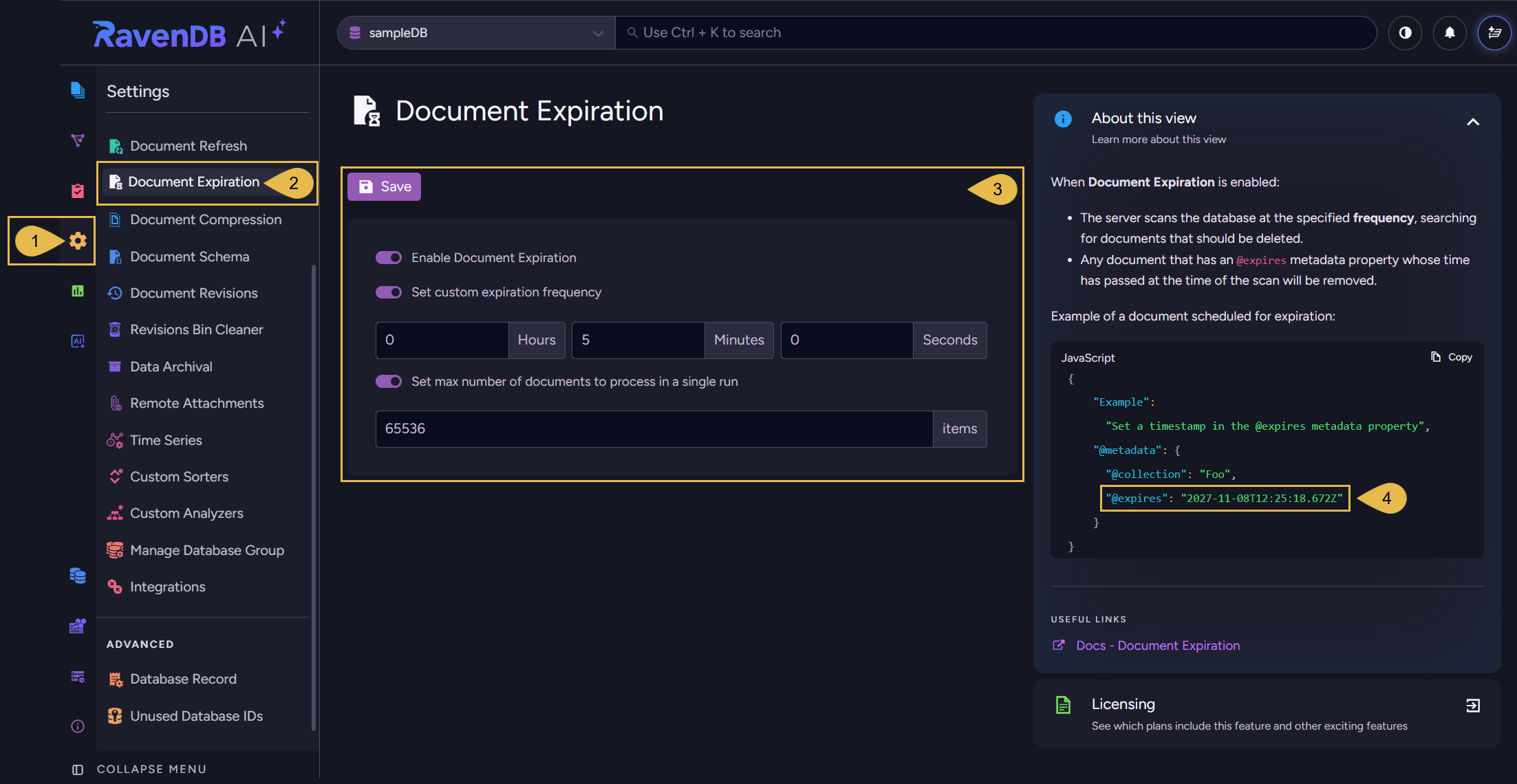
Settings > Document Expiration
-
Settings
Open the Settings menu. -
Document Expiration
Open the Document Expiration view. -
Document Expiration configuration
-
Save
Save the configuration.
Changes to the configuration take effect only after you save them. -
Enable Document Expiration
Toggle this option on to enable document expiration for the database, or off to disable the feature.- Turning this option on also turns on Set max number of documents to process in a single run (see below), with a value of 65536.
- On a license that sets a minimum expiration frequency (e.g., a Community license), turning this option on also turns on Set custom expiration frequency (see below), with the minimum value.
- Turning this option off also turns off the two options below it.
-
Set custom expiration frequency
Toggle this option on to set the interval at which the document expiration feature runs, in hours, minutes, and seconds.
The Hours, Minutes, and Seconds fields appear while this option is on.
Each time the feature runs, it checks the database for documents whose expiration time has passed and deletes these documents.
When this option is off, the default interval (60 seconds) applies.The allowed expiration frequency with a Community license:
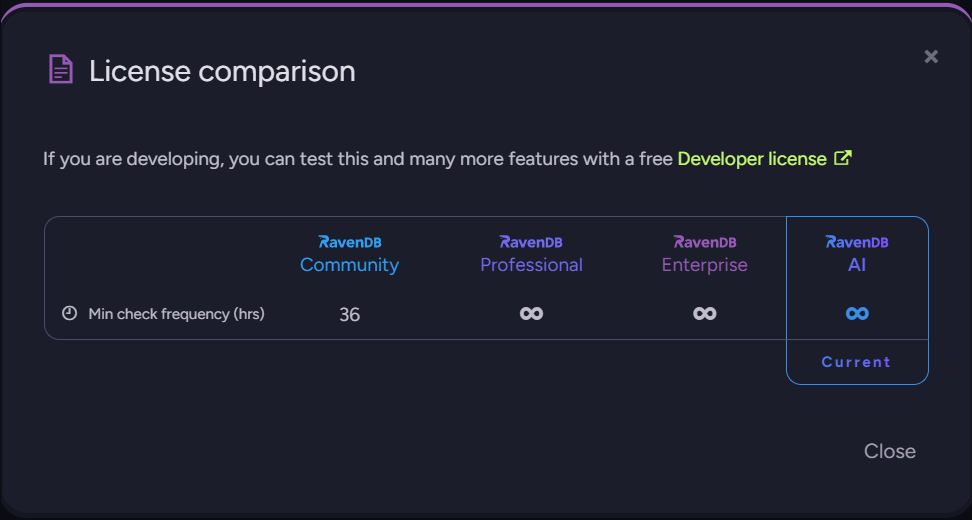
When using a Community license, the document expiration feature cannot run more often than every 36 hours (129600 seconds).
Turning Enable Document Expiration on sets Set custom expiration frequency to this minimum (36 hours).-
To see the minimum expiration interval (in hours) allowed for each license, click the Licensing box at the bottom right of the view to open the License comparison dialog.
-
While document expiration is enabled, a frequency lower than the allowed minimum displays a warning, and Save is disabled.
If you turn Set custom expiration frequency off, the warning will be displayed and Save will be disabled as well, since the 60-second default then applies.
-
-
Set max number of documents to process in a single run
Toggle this option on to limit the number of documents the feature processes in a single run.
When this option is off, any number of documents can be processed during a single run.- Each run processes the documents due for deletion in the order of their expiration times, earliest first.
Documents that share an expiration time are processed in the order of their document IDs. - If the number of documents due for deletion exceeds the set limit, the documents will be processed over multiple consecutive runs.
- Each run processes the documents due for deletion in the order of their expiration times, earliest first.
-
-
Example of a document scheduled for expiration
About this view shows a sample document whose@expiresmetadata property is set to an expiration time one year from today.
See Scheduling a document's expiration below.
Scheduling a document's expiration
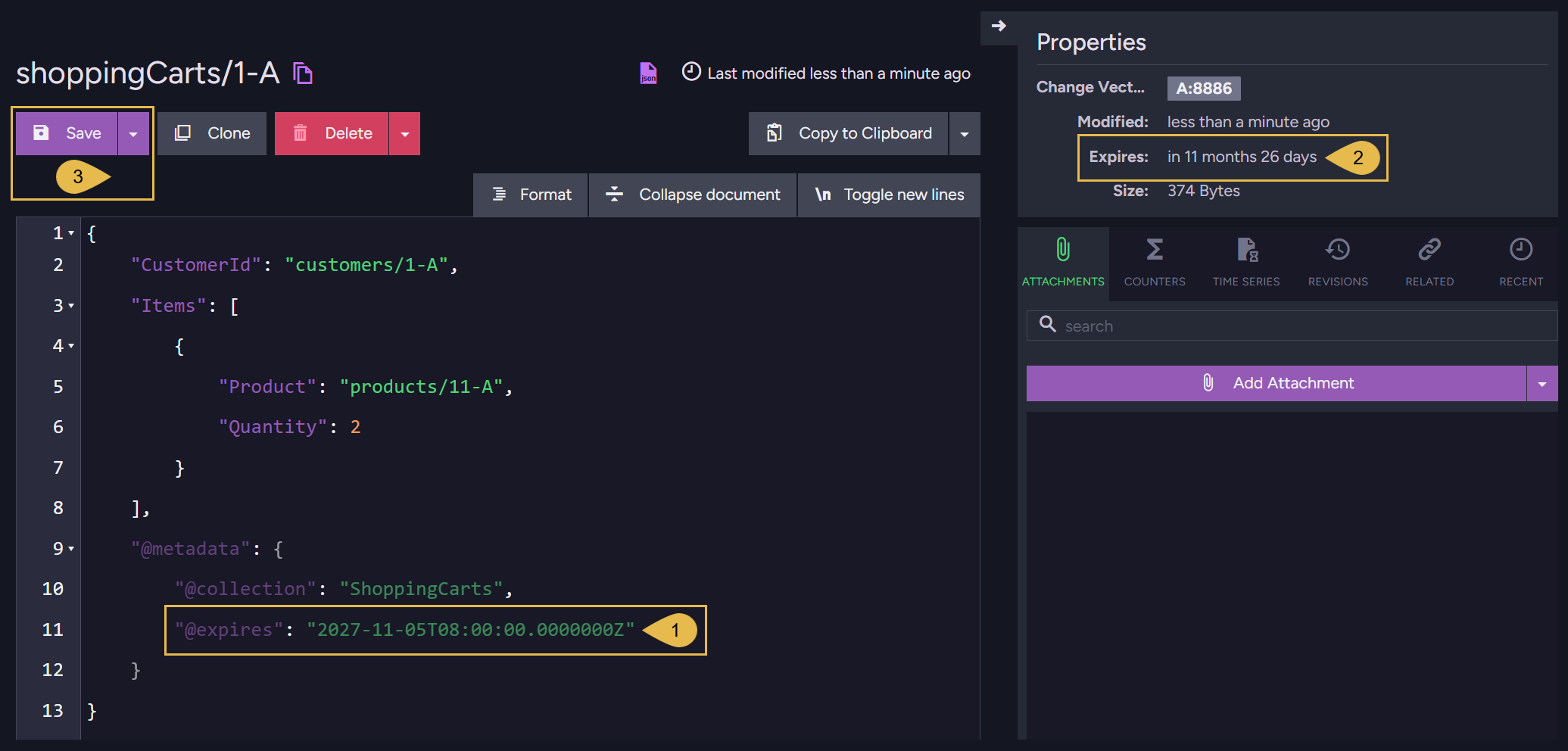
To schedule a document's expiration using Studio, open the document from the
Documents view, add an @expires property
to its metadata, and save the document.
-
@expires
Add an@expiresproperty to the document's@metadata, and set the property's value to the intended expiration time.Add a time zone designator to the value (
Zfor UTC, or an offset from UTC) to specify the time zone of the expiration time.
An expiration time set without a time zone designator is read in the server machine's time zone. If this time zone differs from the one you meant, the document will be deleted earlier or later than you intended.Examples:
"@expires": "2027-11-05T08:00:00.0000000Z"sets the expiration time to 08:00 UTC."@expires": "2027-11-05T10:00:00.0000000+02:00"sets the expiration time to 10:00 in a time zone two hours ahead of UTC, which is 08:00 UTC."@expires": "2027-11-05T08:00:00.0000000"sets the expiration time to 08:00 in the server machine's time zone.
-
Expires
Once the document is saved, the Properties panel, on the right side of the document view, shows the time left until the document's expiration.
Hovering over the time left until the expiration shows the expiration date and time in UTC.If document expiration is disabled for the database, a warning icon is displayed next to the time left until the expiration:

The expiration is still scheduled:
- If you enable the feature before the expiration time, the document will be deleted in the feature's first run after the expiration time.
- If the expiration time passes while the feature is disabled, the document will be deleted after the feature is enabled, during its first run.
- In both cases, the document may be deleted in a later run if the number of documents due for deletion exceeds the maximum set for a single run using the Set max number of documents to process in a single run option above.
-
Save
Save the document.
The expiration is scheduled once you save the document.