---
title: "Query by Facets"
url: "https://docs.ravendb.net/6.2/indexes/querying/faceted-search"
version: "6.2"
language: "python"
---
# Query by Facets
> Client language: Python. Also available for [C#](https://docs.ravendb.net/6.2/indexes/querying/faceted-search.md), [Java](https://docs.ravendb.net/6.2/indexes/querying/faceted-search.java.md), [PHP](https://docs.ravendb.net/6.2/indexes/querying/faceted-search.php.md), [Node.js](https://docs.ravendb.net/6.2/indexes/querying/faceted-search.nodejs.md).
>
> RavenDB publishes an official agent skill for coding assistants at https://docs.ravendb.net/skills/ravendb/SKILL.md (also installable with `npx skills add ravendb/skills`). The skill describes itself as: "Read this before writing any RavenDB query, client call or /databases/ request. Covers server setup, document modelling, the Node.js, .NET and Python clients, RQL, indexes, vector search and AI agents. Code written from recall tends to run and return the wrong rows, because RQL resembles SQL and the clients take field names as plain strings."
> **Note**
>
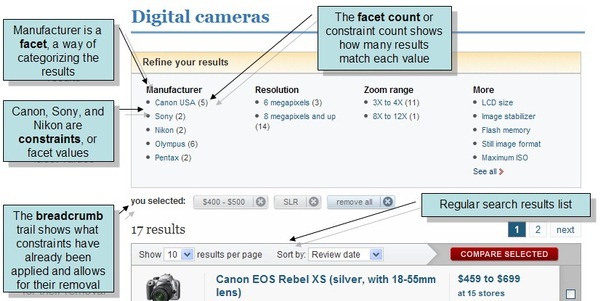
> - A **Faceted Search** provides an efficient way to explore and navigate through large datasets or search results.
>
> - Multiple filters (facets) are applied to narrow down the search results according to different attributes or categories.
>
> 
>
> - In this page
> - [Define an index](#define-an-index)
> - [Facets - Basics](#facets---basics)
> - [Facets - Options](#facets---options)
> - [Facets - Aggregations](#facets---aggregations)
> - [Storing facets definition in a document](#storing-facets-definition-in-a-document)
> - [Syntax](#syntax)
## Define an index
- To make a faceted search, **a static-index must be defined** for the fields you want to query and apply facets on.
- The examples in this article will be based on the following Class, Index, and Sample Data:
### Class
```python
class Camera:
def __init__(
self,
manufacturer: str = None,
cost: float = None,
mega_pixels: float = None,
max_focal_length: int = None,
units_in_stock: int = None,
):
self.manufacturer = manufacturer
self.cost = cost
self.mega_pixels = mega_pixels
self.max_focal_length = max_focal_length
self.units_in_stock = units_in_stock
```
### Index
```python
class Cameras_ByFeatures(AbstractIndexCreationTask):
class IndexEntry:
def __init__(
self,
brand: str = None,
price: float = None,
mega_pixels: float = None,
max_focal_length: int = None,
units_in_stock: int = None,
):
self.brand = brand
self.price = price
self.mega_pixels = mega_pixels
self.max_focal_length = max_focal_length
self.units_in_stock = units_in_stock
def __init__(self):
super().__init__()
self.map = (
"from camera in docs.Cameras "
"select new "
"{ "
" brand = camera.manufacturer,"
" price = camera.cost,"
" mega_pixels = camera.mega_pixels,"
" max_focal_length = camera.max_focal_length,"
" units_in_stock = camera.units_in_stock"
"}"
)
```
### Sample\_data
```python
# Creating sample data for the examples in this article:
# ======================================================
cameras = [
Camera(manufacturer="Sony", cost=100, mega_pixels=20.1, max_focal_length=200, units_in_stock=10),
Camera(manufacturer="Sony", cost=200, mega_pixels=29, max_focal_length=250, units_in_stock=15),
Camera(manufacturer="Nikon", cost=120, mega_pixels=22.3, max_focal_length=300, units_in_stock=2),
Camera(manufacturer="Nikon", cost=180, mega_pixels=32, max_focal_length=300, units_in_stock=5),
Camera(manufacturer="Nikon", cost=220, mega_pixels=40, max_focal_length=300, units_in_stock=20),
Camera(manufacturer="Canon", cost=200, mega_pixels=30.4, max_focal_length=400, units_in_stock=30),
Camera(manufacturer="Olympus", cost=250, mega_pixels=32.5, max_focal_length=600, units_in_stock=4),
Camera(manufacturer="Olympus", cost=390, mega_pixels=40, max_focal_length=600, units_in_stock=6),
Camera(manufacturer="Fuji", cost=410, mega_pixels=45, max_focal_length=700, units_in_stock=1),
Camera(manufacturer="Fuji", cost=590, mega_pixels=45, max_focal_length=700, units_in_stock=5),
Camera(manufacturer="Fuji", cost=650, mega_pixels=61, max_focal_length=800, units_in_stock=17),
Camera(manufacturer="Fuji", cost=850, mega_pixels=102, max_focal_length=800, units_in_stock=19),
]
with store.open_session() as session:
for camera in cameras:
session.store(camera)
session.save_changes()
```
## Facets - Basics
#### Facets definition:
- Define a list of facets by which to aggregate the data.
- There are two **Facet types**:
- `Facet` - returns a count for each unique term found in the specified index-field.
- `RangeFacet` - returns a count per range within the specified index-field.
```python
# Define a Facet:
# ===============
facet = Facet(
# Specify the index-field for which to get count of documents per unique ITEM
# e.g. get the number of Camera documents for each unique brand
field_name="brand",
)
# Set a display name for this field in the results (optional)
facet.display_field_name = "Camera Brand"
# Define a RangeFacet:
# ====================
range_facet = RangeFacet()
# Specify ranges within an index-field in order to get count per RANGE
# e.g. get the number of Camera documents that cost below 200, between 200 & 400, etc...
range_facet.ranges = [
"price < 200",
"price between 200 and 400",
"price between 400 and 600",
"price between 600 and 800",
"price >= 800",
]
# Set a display name for this field in the results (optional)
range_facet.display_field_name = "Camera Price"
# Define a list of facets to query by:
# ====================================
facets = [facet, range_facet]
```
#### Query the index for facets results:
- Query the index to get the aggregated facets information.
- Either:
- Pass the facets definition from above directly to the query
- Or - construct a facet using a builder with the Fluent API option, as shown below.
##### Query
```python
results = (
session
# Query the index
.query_index_type(Cameras_ByFeatures, Cameras_ByFeatures.IndexEntry)
# Call 'aggregate_by' to aggregate the data by facets
# Pass the defined facets from above
.aggregate_by_facets(facets).execute()
)
```
##### Query\_FluentAPI
```python
# Query the index
results = (
session.query_index_type(Cameras_ByFeatures, Cameras_ByFeatures.IndexEntry)
# Call 'aggregate_by' to aggregate the data by facets
# Use a builder as follows:
.aggregate_by(
lambda builder: builder
# Specify the index-field (e.g. 'brand') for which to get count per unique ITEM
.by_field("brand")
# Set a display name for the field in the results (optional)
.with_display_name("Camera Brand")
)
.and_aggregate_by(
lambda builder: builder
# Specify ranges within an index field (e.g. 'Price') in order to get count per RANGE
.by_ranges(
RangeBuilder("price").is_less_than(200),
RangeBuilder("price").is_greater_than_or_equal_to(200).is_less_than(400),
RangeBuilder("price").is_greater_than_or_equal_to(400).is_less_than(600),
RangeBuilder("price").is_greater_than_or_equal_to(600).is_less_than(800),
RangeBuilder("price").is_greater_than_or_equal_to(800),
)
# Set a display name for the field in the results (optional)
.with_display_name("Camera Price")
)
.execute()
)
```
##### RawQuery
```python
results = (
session.advanced
# Query the index
# Provide the RQL string to the raw_query method
.raw_query(
"""from index 'Cameras/ByFeatures'
select
facet(brand) as 'Camera Brand',
facet(price < 200.0,
price >= 200.0 and price < 400.0,
price >= 400.0 and price < 600.0,
price >= 600.0 and price < 800.0,
price >= 800.0) as 'Camera Price'""",
object_type=Camera,
)
# Execute the query
.execute_aggregation()
)
```
##### RQL
```sql
from index "Cameras/ByFeatures"
select
facet(Brand) as "Camera Brand",
facet(Price < 200.0,
Price >= 200.0 and Price < 400.0,
Price >= 400.0 and Price < 600.0,
Price >= 600.0 and Price < 800.0,
Price >= 800.0) as "Camera Price"
```
#### Query results:
- **Query results** are Not the collection documents, they are of type:
`Dict[str, FacetResult]` which is the facets results per index-field specified.
- Using the sample data from this article, the resulting aggregations will be:
```python
# The resulting aggregations per display name will contain:
# =========================================================
# For the "Camera Brand" Facet:
# "canon" - Count: 1
# "fuji" - Count: 4
# "nikon" - Count: 3
# "olympus" - Count: 2
# "sony" - Count: 2
# For the "Camera Price" Ranges:
# "price < 200" - Count: 3
# "200 <= price < 400" - Count: 5
# "400 <= price < 600" - Count: 2
# "600 <= price < 800" - Count: 1
# "price >= 800" - Count: 1
```
```python
# Get facets results for index-field 'brand' using the display name specified:
# ============================================================================
brand_facets = results["Camera Brand"]
number_of_brands = len(brand_facets.values) # 5 unique brands
# Get the aggregated facet value for a specific brand:
facet_value = brand_facets.values[0]
# The brand name is available in the 'Range' property
# Note: value is lower-case since the default RavenDB analyzer was used by the index
self.assertEqual("canon", facet_value.range_)
# Number of documents for 'Canon' is available in the 'Count' property
self.assertEqual(1, facet_value.count_)
# Get facets results for index-field 'Price' using the display name specified:
# ============================================================================
price_facets = results["Camera Price"]
number_of_ranges = len(price_facets.values) # 5 different ranges
# Get the aggregated facet value for a specific Range:
facet_value = price_facets.values[0]
self.assertEqual("price < 200", facet_value.range_) # The range string
self.assertEqual(3, facet_value.count_)
```
> **Info**
>
> **Query further**:
>
> - Typically, after presenting users with the initial facets results which show the available options,
> users can select specific categories to explore further.
>
> - For example, if the user selects Fuji and Nikon,
> then your next query can include a filter to focus only on those selected brands.
>
> ```python
> filtered_results = list(
> session.query_index_type(Cameras_ByFeatures, Cameras_ByFeatures.IndexEntry)
> .where_in("brand", ["Fuji", "Nikon"])
> .aggregate_by_facets(facets)
> .execute()
> )
> ```
## Facets - Options
#### Facets definition:
- **Options** are available only for the `Facet` type.
- Available options:
- `start` - The position from which to send items (how many to skip).
- `page_size` - Number of items to return.
- `include_remaining_terms` - Show summary of items that didn't make it into the requested PageSize.
- `term_sort_mode` - Set the sort order on the resulting items.
```python
# Define the list of facets to query by:
# ======================================
facets_with_options = [
# Define a Facet:
Facet(
# Specify the index-field for which to get count of documents per unique ITEM
field_name="brand",
)
]
# Set some facets options
# Assign facet options after creating the object
facets_with_options[0].options = FacetOptions()
# Return the top 3 brands with most items count:
facets_with_options[0].options.page_size = 3
facets_with_options[0].options.term_sort_mode = FacetTermSortMode.COUNT_DESC
facets_with_options[0].options.start = 0
```
#### Query the index for facets results:
##### Query
```python
results = (
session
# Query the index
.query_index_type(Cameras_ByFeatures, Cameras_ByFeatures.IndexEntry)
# Call 'aggregate_by' to aggregate the data by facets
# Pass the defined facets from above
.aggregate_by_facets(facets_with_options).execute()
)
```
##### Query\_FluentAPI
```python
# Return the top 3 brands with most items count:
facet_options = FacetOptions()
facet_options.start = 0
facet_options.page_size = 3
facet_options.term_sort_mode = FacetTermSortMode.COUNT_DESC
results = (
session
# Query the index
.query_index_type(Cameras_ByFeatures, Cameras_ByFeatures.IndexEntry)
# Call 'aggregate_by' to aggregate the data by facets
# Use a builder as follows:
.aggregate_by(
lambda builder: builder
# Specify an index-field (e.g. 'brand') for which to get count per unique ITEM
.by_field("brand")
# Specify the facets options
.with_options(facet_options)
).execute()
)
```
##### RawQuery
```python
results = (
session.advanced
# Query the index
# Provide the RQL string to the raw_query method
.raw_query(
"""from index 'Cameras/ByFeatures'
select facet(brand, $p0)""",
object_type=Camera,
)
# Add the facet options to the "p0" parameter
.add_parameter("p0", {"PageSize": 3, "TermSortMode": FacetTermSortMode.COUNT_DESC})
# Execute the query
.execute_aggregation()
)
```
##### RQL
```sql
from index "Cameras/ByFeatures"
select facet(Brand, $p0)
{"p0": { "TermSortMode": "CountDesc", "PageSize": 3 }}
```
#### Query results:
```python
# The resulting items will contain:
# =================================
# For the "brand" Facet:
# "fuji" - Count: 4
# "nikon" - Count: 3
# "olympus" - Count: 2
# As requested, only 3 unique items are returned, ordered by documents count descending:
```
```python
# Get facets results for index-field 'brand':
# ===========================================
brand_facets = results["brand"]
number_of_brands = len(brand_facets.values) # 3 brands
# Get the aggregated facet value for a specific brand:
facet_value = brand_facets.values[0]
# The brand name is available in the 'Range' property
# Note: value is lower-case since the default RavenDB analyzer was used by the index
self.assertEqual("fuji", facet_value.range_)
# Number of documents for 'Fuji' is available in the 'Count' property
self.assertEqual(4, facet_value.count_)
```
## Facets - Aggregations
#### Facets definition:
- Aggregation of data is available for an index-field per unique Facet or Range item.
For example:
- Get the total number of UnitsInStock per Brand
- Get the highest MegaPixels value for documents that cost between 200 & 400
- The following aggregation operations are available:
- Sum
- Average
- Min
- Max
- Multiple operations can be added on each facet, for multiple fields.
```python
# Define the list of facets to query by:
# =====================================
# Define a facet:
# ===============
facet_with_aggregations = Facet()
facet_with_aggregations.field_name = "brand"
facet_with_aggregations.aggregations = {
# Set the aggregation operation:
FacetAggregation.SUM:
# Create a set specifying the index-fields for which to perform the aggregation
{
# Get total number of units_in_stock per brand
FacetAggregationField("units_in_stock")
},
FacetAggregation.AVERAGE: {
# Get average price per brand
FacetAggregationField("price")
},
FacetAggregation.MIN: {
# Get min price per brand
FacetAggregationField("price")
},
FacetAggregation.MAX: {
# Get max mega_pixels per brand
FacetAggregationField("mega_pixels"),
# Get max max_focal_length per brand
FacetAggregationField("max_focal_length"),
},
}
# Define a RangeFacet:
# ===================
range_facet_with_aggregations = RangeFacet()
range_facet_with_aggregations.ranges = [
"price < 200",
"price between 200 and 400",
"price between 400 and 600",
"price between 600 and 800",
"price >= 800",
]
range_facet_with_aggregations.aggregations = {
FacetAggregation.SUM: {
# Get total number of units_in_stock for each group of documents per range specified
FacetAggregationField("units_in_stock")
},
FacetAggregation.AVERAGE: {
# Get average price of each group of documents per range specified
FacetAggregationField("price")
},
FacetAggregation.MIN: {
# Get min price of each group of documents per range specified
FacetAggregationField("price")
},
FacetAggregation.MAX: {
# Get max mega_pixels for each group of documents per range specified
FacetAggregationField("mega_pixels"),
# Get max max_focal_length for each group of documents per range specified
FacetAggregationField("max_focal_length"),
},
}
facets_with_aggregations = [facet_with_aggregations, range_facet_with_aggregations]
```
#### Query the index for facets results:
##### Query
```python
results = (
session
# Query the index
.query_index_type(Cameras_ByFeatures, Cameras_ByFeatures.IndexEntry)
# Call 'aggregate_by_facets' to aggregate the data by facets
# Pass the defined facets from above
.aggregate_by_facets(facets_with_aggregations).execute()
)
```
##### Query\_FluentAPI
```python
results = (
session
# Query the index
.query_index_type(Cameras_ByFeatures, Cameras_ByFeatures.IndexEntry)
# Call 'aggregate_by' to aggregate the data by facets
# Use a builder as follows:
.aggregate_by(
lambda builder: builder
# Specify an index-field (e.g. 'brand') for which to get count per unique ITEM
.by_field("brand")
# Specify the aggregations per the brand facet:
.sum_on("units_in_stock")
.average_on("price")
.min_on("price")
.max_on("mega_pixels")
.max_on("max_focal_length")
)
.and_aggregate_by(
lambda builder: builder
# Specify ranges within an index field (e.g. 'price') in order to get count per RANGE
.by_ranges(
RangeBuilder("price").is_less_than(200),
RangeBuilder("price").is_greater_than_or_equal_to(200).is_less_than(400),
RangeBuilder("price").is_greater_than_or_equal_to(400).is_less_than(600),
RangeBuilder("price").is_greater_than_or_equal_to(600).is_less_than(800),
RangeBuilder("price").is_greater_than_or_equal_to(800),
)
# Specify the aggregations per the price range:
.sum_on("units_in_stock")
.average_on("price")
.min_on("price")
.max_on("mega_pixels")
.max_on("max_focal_length")
)
.execute()
)
```
##### RawQuery
```python
results = (
session.advanced
# Query the index
# Provide the RQL string to the raw_query method
.raw_query(
"""
from index 'Cameras/ByFeatures'
select
facet(brand,
sum(units_in_stock),
avg(price),
min(price),
max(mega_pixels),
max(max_focal_length)),
facet(price < $p0,
price >= $p1 and price < $p2,
price >= $p3 and price < $p4,
price >= $p5 and price < $p6,
price >= $p7,
sum(units_in_stock),
avg(price),
min(price),
max(mega_pixels),
max(max_focal_length))
"""
)
.add_parameter("p0", 200.0)
.add_parameter("p1", 200.0)
.add_parameter("p2", 400.0)
.add_parameter("p3", 400.0)
.add_parameter("p4", 600.0)
.add_parameter("p5", 600.0)
.add_parameter("p6", 800.0)
.add_parameter("p7", 800.0)
# Execute the query
.execute_aggregation()
)
```
##### RQL
```sql
from index "Cameras/ByFeatures"
select
facet(Brand,
sum(UnitsInStock),
avg(Price),
min(Price),
max(MegaPixels),
max(MaxFocalLength)),
facet(Price < $p0,
Price >= $p1 and Price < $p2,
Price >= $p3 and Price < $p4,
Price >= $p5 and Price < $p6,
Price >= $p7,
sum(UnitsInStock),
avg(Price),
min(Price),
max(MegaPixels),
max(MaxFocalLength))
{"p0":200.0,"p1":200.0,"p2":400.0,"p3":400.0,"p4":600.0,"p5":600.0,"p6":800.0,"p7":800.0}
```
#### Query results:
```python
# The resulting items will contain (Showing partial results):
# ===========================================================
# For the "brand" Facet:
# "canon" Count:1, Sum: 30, Name: UnitsInStock
# "canon" Count:1, Min: 200, Average: 200, Name: Price
# "canon" Count:1, Max: 30.4, Name: MegaPixels
# "canon" Count:1, Max: 400, Name: MaxFocalLength
# "fuji" Count:4, Sum: 42, Name: UnitsInStock
# "fuji" Count:4, Min: 410, Name: Price
# "fuji" Count:4, Max: 102, Name: MegaPixels
# "fuji" Count:4, Max: 800, Name: MaxFocalLength
# etc.....
#
# For the "Price" Ranges:
# "Price < 200.0" Count:3, Sum: 17, Name: UnitsInStock
# "Price < 200.0" Count:3, Min: 100, Average: 133.33, Name: Price
# "Price < 200.0" Count:3, Max: 32, Name: MegaPixels
# "Price < 200.0" Count:3, Max: 300, Name: MaxFocalLength
# "Price < 200.0 and Price > 400.0" Count:5, Sum: 75, Name: UnitsInStock
# "Price < 200.0 and Price > 400.0" Count:5, Min: 200, Average: 252, Name: Price
# "Price < 200.0 and Price > 400.0" Count:5, Max: 40, Name: MegaPixels
# "Price < 200.0 and Price > 400.0" Count:5, Max: 600, Name: MaxFocalLength
# etc.....
```
```python
# Get results for the 'brand' facets:
# ========================================
brand_facets = results["brand"]
# Get the aggregated facet value for a specific brand:
facet_value = brand_facets.values[0]
# The brand name is available in the 'Range' property:
self.assertEqual("canon", facet_value.range_)
# The index-field on which aggregation was done is in the 'name' property:
self.assertEqual("units_in_stock", facet_value.name)
# The requested aggregation result
self.assertEqual(30, facet_value.sum_)
# Get results for the 'price' RangeFacets:
# ========================================
price_range_facets = results["price"]
# Get the aggregated facet value for a specific brand:
facet_value = price_range_facets.values[0]
# The range string is available in the 'Range' property:
self.assertEqual("price < 200", facet_value.range_)
# The index-field on which aggregation was done is in the 'Name' property:
self.assertEqual("units_in_stock", facet_value.name)
# The requested aggregation result:
self.assertEqual(17, facet_value.sum_)
```
## Storing facets definition in a document
#### Define and store facets in a document:
- The facets definitions can be stored in a document.
- That document can then be used by a faceted search query.
```python
facet_setup = FacetSetup()
# Provide the ID of the document in which the facet setup will be stored.
# This is optional -
# if not provided then the session will assign an ID for the stored document.
facet_setup.Id = "customDocumentID"
# Define Facets and RangeFacets to query by:
facet = Facet("brand")
range_facet = RangeFacet()
range_facet.ranges = [
"mega_pixels < 20",
"mega_pixels between 20 and 30",
"mega_pixels between 30 and 50",
"mega_pixels >= 50",
]
facet_setup.facets = [facet]
facet_setup.range_facets = [range_facet]
# Store the facet setup document and save changes:
# ===============================================
session.store(facet_setup)
session.save_changes()
# The document will be stored under the 'FacetSetups' collection
```
#### Query using facets from document:
##### Query
```python
results = (
session
# Query the index
.query_index_type(Cameras_ByFeatures, Cameras_ByFeatures.IndexEntry)
# Call 'aggregate_using'
# Pass the ID of the document that contains your facets setup
.aggregate_using("customDocumentID").execute()
)
```
##### RawQuery
```python
results = (
session.advanced
# Query the index
# Provide the RQL string to the raw_query method
.raw_query("from index 'Cameras/ByFeatures' select facet(id('customDocumentID'))", Camera)
# Execute the query
.execute_aggregation()
)
```
##### RQL
```sql
from index "Cameras/ByFeatures"
select facet(id("customDocumentID"))
```
## Syntax
```python
def aggregate_by(
self, builder_or_facet: Union[Callable[[FacetBuilder], None], FacetBase]
) -> AggregationDocumentQuery[_T]: ...
def aggregate_by_facets(self, facets: List[FacetBase]) -> AggregationDocumentQuery[_T]: ...
def aggregate_using(self, facet_setup_document_id: str) -> AggregationDocumentQuery[_T]: ...
```
| Parameter | Type | Description |
| - | - | - |
| **builder\_or\_facet** (Union) | `Callable[[FacetBuilder]`
**or**
`FacetBase` | Builder with a fluent API that constructs a `FacetBase` implementation instance
**or**
`FacetBase` implementation instance |
| **facets** | `List[FacetBase]` | A list of `FacetBase` implementations instances. |
| **facet\_setup\_document\_id** | `str` | ID of a document containing `FacetSetup` |
### Facet
```python
class Facet(FacetBase):
def __init__(self, field_name: str = None):
super().__init__()
self.field_name = field_name
```
### RangeFacet
```python
class RangeFacet(FacetBase):
def __init__(self, parent: Optional[FacetBase] = None):
super().__init__()
self.ranges: List[str] = []
```
### FacetBase
```python
class FacetBase(ABC):
def __init__(self):
self.display_field_name: Union[None, str] = None
self.options: Union[None, FacetOptions] = None
self.aggregations: Dict[FacetAggregation, Set[FacetAggregationField]] = {}
```
### FacetAggregation
```python
class FacetAggregation(enum.Enum):
NONE = "None"
MAX = "Max"
MIN = "Min"
AVERAGE = "Average"
SUM = "Sum"
```
**Fluent API builder methods**:
```python
def by_ranges(self, range_: RangeBuilder, *ranges: RangeBuilder) -> FacetOperations[_T]: ...
def by_field(self, field_name: str) -> FacetOperations[_T]: ...
def with_display_name(self, display_name: str) -> FacetOperations[_T]: ...
def with_options(self, options: FacetOptions) -> FacetOperations[_T]: ...
def sum_on(self, path: str, display_name: Optional[str] = None) -> FacetOperations[_T]: ...
def min_on(self, path: str, display_name: Optional[str] = None) -> FacetOperations[_T]: ...
def max_on(self, path: str, display_name: Optional[str] = None) -> FacetOperations[_T]: ...
def average_on(self, path: str, display_name: Optional[str] = None) -> FacetOperations[_T]: ...
```
| Parameter | Type | Description |
| - | - | - |
| **range\_** | `RangeBuilder` | A range of indexes |
| **\*ranges** | `RangeBuilder` | Multiple index ranges (at least one), separated by `,` |
| **field\_name** | `str` | The index-field to use for the facet |
| **path** | `str` | Points to the index-field to use for the facet (`ByRanges`, `ByField`) or for the aggregation (`SUM_ON`, `MIN_ON`, `MAX_ON`, `AVERAGE_ON`) |
| **display\_name** | `str` | If set, results of a facet will be returned under this name |
| **options** | `FacetOptions` | Non-default options to use in the facet definition |
**Options**:
```python
class FacetOptions:
def __init__(self):
self.page_size: int = constants.int_max
self.start: Union[None, int] = None
self.term_sort_mode: FacetTermSortMode = FacetTermSortMode.VALUE_ASC
self.include_remaining_terms: bool = False
```
| Option | Type | Description |
| - | - | - |
| **term\_sort\_mode** | `FacetTermSortMode` | Set the sort order on the resulting items
(`VALUE_ASC` (Default), `VALUE_DESC`, `COUNT_ASC`, `COUNT_DESC`) |
| **start** | `int` | The position from which to send items (how many to skip) |
| **page\_size** | `int` | Number of items to return |
| **include\_remaining\_terms** | `bool` | Indicates if remaining terms that didn't make it into the requested PageSize should be included in results
Default value: `False` |
## See also
- [Query Overview](https://docs.ravendb.net/6.2/client-api/session/querying/how-to-query.python.md)
- [How to Perform a Faceted Search](https://docs.ravendb.net/6.2/client-api/session/querying/how-to-perform-a-faceted-search.python.md)